
Agentic AI in Marketing: How AI Agents Are Changing Marketing
Come to think of it, AI is now so much more than just writing captions and generating images. Generative AI has helped marketers create content faster. But now, Agentic AI is moving towards taking actions, not just generating output.
Before we dwell into the hows and whys, let’s understand what Agentic AI is.
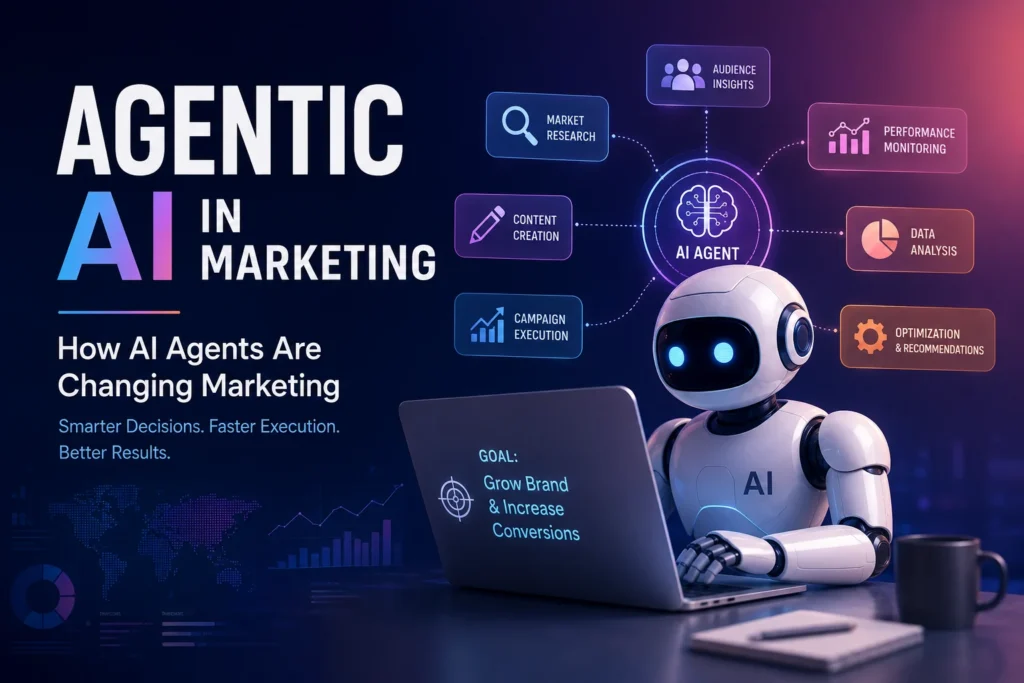
What is Agentic AI?
Agentic AI is a type of artificial intelligence that can understand a goal, make decisions, plan multiple steps, and take actions with limited human intervention. Unlike traditional AI tools that mainly respond to specific prompts, AI agents can work toward a broader objective by analyzing information, choosing the next action, and adapting based on the results.
A simple way to distinguish between Agentic AI and ordinary automation is by its ability to pursue goals, use tools, make decisions, and adapt with limited supervision.
What this mean for Marketers?
or marketers, this means AI is moving beyond simply generating content, writing ad copy, or analyzing data. Agentic AI can potentially help with tasks such as market research, campaign optimization, audience analysis, content planning, and performance monitoring. In simple terms, generative AI creates; agentic AI acts.
Now let us understand the difference between Traditional Automation, Generative AI and Agentic AI
Traditional Automation
- Follows predefined rules — works based on fixed instructions and workflows.
- Performs specific tasks — handles repetitive, predictable activities.
- If X happens, do Y — actions are triggered by predefined conditions.
- Limited flexibility — cannot easily adapt when situations change.
- Example: Automatically send an email after a customer makes a purchase.
Generative AI
- Generates content or responses — creates text, images, ideas, code, etc.
- Responds to prompts — requires a user to provide instructions.
- Create X for me — produces an output based on the given request.
- Requires user direction — the user generally decides what to ask and what to do next.
- Example: Ask AI to write five ad copies for a new product.
Agentic AI
- Works toward a defined goal — focuses on achieving an objective rather than completing just one task.
- Plans and executes multiple steps — can break a goal into smaller actions.
- Achieve X; determine the steps — decides what actions may be needed to reach the objective.
- Can make decisions within defined boundaries — operates with a certain level of autonomy while following set permissions and guardrails.
- Example: Analyze campaign performance, identify underperforming areas, and determine what should happen next.
How Can Agentic AI Be Used in Marketing?
The potential applications of agentic AI extend across different parts of the marketing workflow.
Market Research
Market research involves collecting and interpreting large amounts of information.
How an AI agent could potentially help marketers:
- Research competitors
- Monitor industry trends
- Analyze customer feedback
- Identify changes in consumer behavior
- Compare competitor messaging
- Organize research findings
- Identify potential market opportunities
Instead of manually asking an AI tool to perform each research task, an agent could coordinate multiple steps around a specific research objective.
Content Planning and Creation
Content marketing is another area where agentic workflows could become useful. For example, a marketer could provide an objective such as “Create a content plan to increase awareness among first-time buyers.”
When this happens, an AI agent could potentially research the audience, identify relevant topics, analyze existing content, suggest content gaps and develop a suitable content calendar. Generative AI can then assist with individual assets such as blog drafts, social media captions, email copy or creative concepts.
The important distinction is that the agent is coordinating the workflow, rather than simply generating one piece of content.
Performance Marketing
Agentic AI in performance marketing comes with an interesting twist because campaigns generate continuous feedback. A campaign doesn’t simply launch and stop. Marketers monitor metrics such as:
- Click-through rate
- Conversion rate
- Cost per acquisition
- Return on ad spend
- Engagement
- Frequency
An agentic system could potentially monitor these signals continuously, identify unusual changes and recommend adjustments.
If we are explaining this with an example, If or when a campaign performance drops, the agent investigates possible causes, compares creative and audience performance, identifies the likely issue, recommends a change and finally marketer approves the action.
SEO and Search Visibility
SEO involves many connected activities. An AI agent could potentially help with:
- Keyword research
- Competitor analysis
- Content gap analysis
- Content briefs
- Internal linking opportunities
- Technical SEO checks
- Search performance monitoring
- Identifying pages that need updating
The advantage is not simply that AI can perform each individual task. The bigger opportunity is that an agent could potentially connect these tasks into a continuous workflow.
Reporting and Optimization
Marketing reports often involve collecting data from several platforms, organizing it and turning numbers into insights. An agent could potentially monitor marketing data, identify significant changes, explain possible reasons and prepare a summary for the marketing team.
What Are the Benefits of Agentic AI in Marketing?
One of the biggest benefits of agentic AI in marketing is its ability to connect multiple tasks into a single, goal-oriented workflow. Instead of requiring marketers to manually initiate every step, AI agents can potentially handle tasks such as data collection, campaign monitoring, analysis and routine optimization with greater speed and scale.
They can continuously monitor marketing performance, identify changes and help marketers respond faster. This can also make experimentation easier by allowing teams to test and evaluate more variations in less time. By taking care of repetitive operational tasks such as reporting, monitoring and routine analysis, agentic AI could give marketers more time to focus on areas where human judgment matters most, such as strategy, creativity, consumer psychology and brand building.
But is agentic AI really autonomous?
Not necessarily. Not every tool marketed as an AI agent can independently make decisions or take actions. Some systems may simply combine generative AI with predefined workflows and automation, while more advanced agents can plan tasks, use tools, evaluate results and adapt their next steps. In marketing, human oversight is still important because decisions around brand voice, budgets, customer data and business strategy often require context that AI may not fully understand. Rather than asking whether an AI system is completely autonomous, it is more useful to ask what decisions it can make, what actions it can take, and how much human control remains in the process.
What Are the Risks of Agentic AI in Marketing?
As agentic AI becomes more capable of making decisions and taking actions, it also introduces new risks for marketers. An AI agent may misinterpret data, make inappropriate decisions, produce content that does not align with a brand’s voice, or act on incomplete information. There are also concerns around data privacy, brand safety, bias and over-automation, particularly when agents have access to customer information or marketing platforms. Unlike a simple AI-generated draft, an autonomous action can have real business consequences. This is why marketers need clear boundaries, permissions and human oversight to ensure that AI supports marketing decisions rather than making critical decisions without appropriate supervision.
Will Agentic AI Replace Marketers?
Agentic AI is unlikely to simply replace marketers, but it could significantly change what marketers do. As AI agents take on more repetitive tasks such as research, reporting, campaign monitoring and routine optimization, marketers may have more time to focus on strategy, creativity, consumer psychology and brand building. The role could gradually shift from manually executing every marketing task to setting objectives, guiding AI systems, evaluating their decisions and making higher-level strategic choices. In this sense, the future may be less about AI versus marketers and more about marketers who know how to work effectively with AI.
The Future of Agentic AI in Marketing
The future of agentic AI in marketing could move toward more connected and autonomous workflows, where AI systems can coordinate research, content, advertising, customer engagement and performance analysis around a common business goal. However, the technology is still evolving, and not every marketing task needs to be automated. The real advantage may come from knowing where AI can improve speed and scale while keeping human judgment at the center of important decisions. As agentic AI develops, marketers who understand both the capabilities and limitations of these systems may be better positioned to use them strategically rather than simply following the latest AI trend.
What do you think? Will agentic AI become a marketer’s biggest advantage, or create more challenges than opportunities? Share your thoughts in the comments. If you want to connect and discuss click here!